 AI-generated
The Science
The Science of the
Scalp Environment
Understanding the biological environment in which hair follicles function.
Introduction
Hair begins beneath the surface
Hair is often treated as if it were an isolated fibre that can be strengthened or repaired directly.
In reality every hair originates from a follicle embedded deep within the scalp. This follicle exists within a biological environment composed of surrounding tissue, blood supply and metabolic processes.
Understanding this environment is essential for understanding hair growth.
CuraCap formulations are designed with this environment in mind.
The Hair Follicle
The follicle as a biological structure
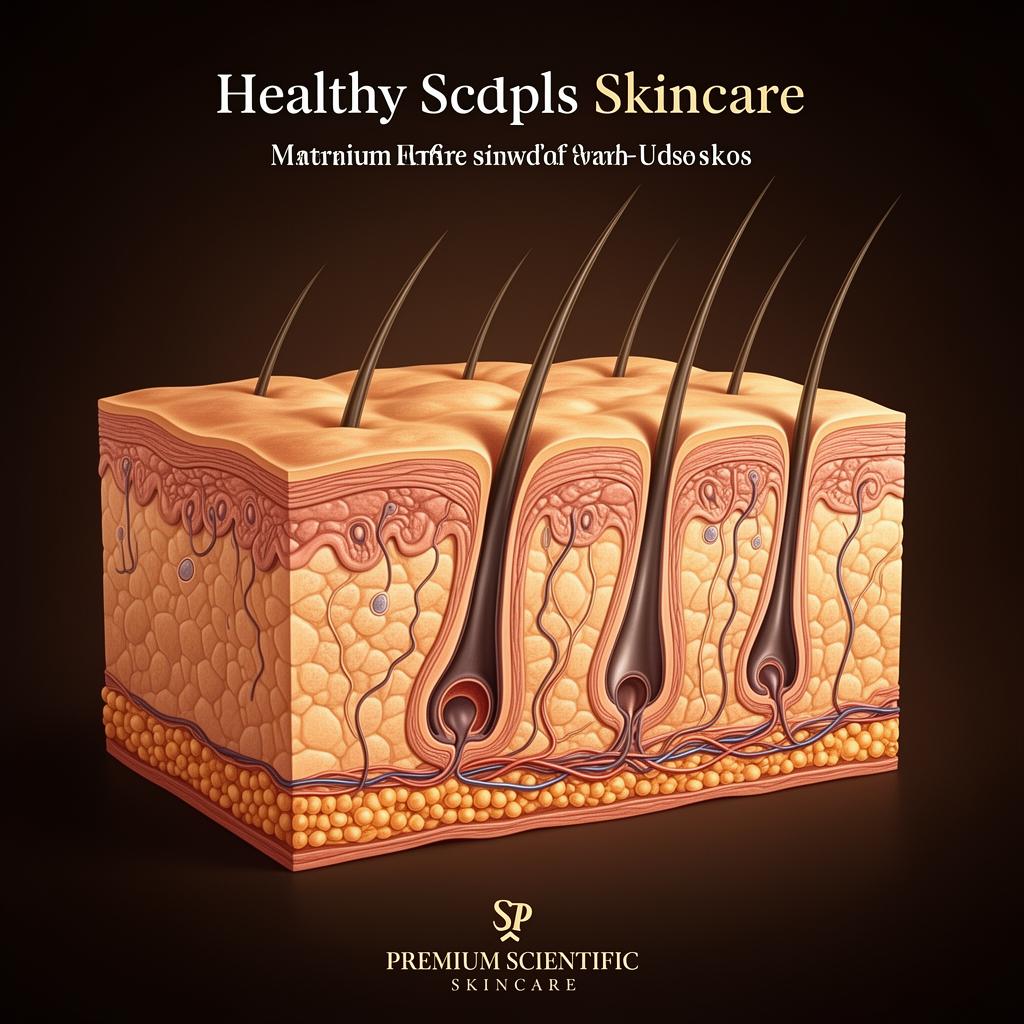
Each hair grows from a follicle that sits several millimetres beneath the surface of the scalp.
The follicle is not a simple tube but a complex structure consisting of multiple cell types that coordinate hair growth.
These cells require nutrients, oxygen and metabolic support to function normally.
Changes in this environment can influence how the follicle behaves over time.
 AI-generated
The Scalp Environment
The environment surrounding the follicle
The follicle interacts continuously with its surrounding environment. Important factors include:
Local blood circulation
Delivers oxygen and nutrients to the follicle cells.
Cellular metabolism
Supports the energy requirements of dividing hair matrix cells.
Nutrient availability
Vitamins and cofactors involved in keratin synthesis and tissue maintenance.
Scalp microbiome balance
The community of microorganisms that interacts with the skin surface.
Structural tissue support
The connective tissue surrounding the follicle providing mechanical and biochemical support.
When this environment changes, the behaviour of the follicle may change as well.
This concept is referred to as the scalp environment.
Formulation Logic
Why formulation matters for the scalp
Many hair products focus primarily on the hair fibre itself. These formulations often contain conditioning agents, silicones or fragrances designed to influence how hair looks or feels.
CuraCap approaches scalp care differently.
The formulation is designed to interact with the scalp environment rather than the hair fibre. This leads to highly concentrated formulations containing only a small number of functional ingredients.
Functional Ingredients
Functional ingredients with a biochemical role
Every CuraCap serum contains six to seven ingredients. For each functional ingredient, this section states its role in cellular metabolism — and the studies behind it. We label the type of evidence: human study, in-vitro data, or established biochemistry.
Biotin (Vitamin B7)
Human study · ReviewBiotin is a coenzyme for carboxylases — enzymes of fatty acid and amino acid metabolism relevant for the maintenance of healthy skin and hair [1]. In one study of women complaining of hair loss, 38% showed biotin deficiency [1]. Evidence for a benefit of biotin without a proven deficiency is limited [2] — we claim nothing beyond that.
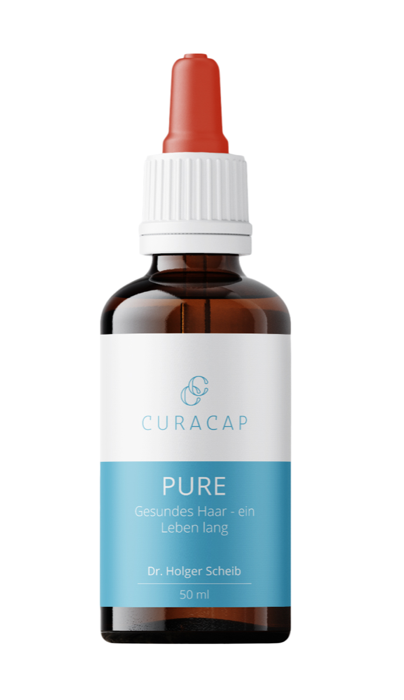
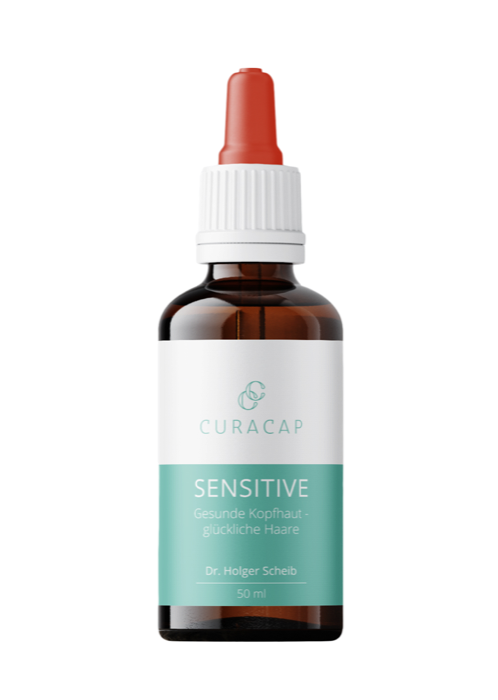
Contained in PURE, SENSITIVE and MEN.
Niacin (Vitamin B3)
Human study · ReviewNiacin is the precursor of the coenzymes NAD and NADP, which transfer hydrogen in the energy metabolism of every cell [3]. Topically applied niacinamide — interconvertible with niacin in the organism — stabilises the epidermal barrier function [3]. In a placebo-controlled pilot study of 60 women, topical niacin derivatives significantly increased hair fullness after six months (p = 0.04) [4]. That study tested derivatives, not this serum.
Contained in PURE, SENSITIVE and MEN.
Pantothenic Acid (Vitamin B5)
ReviewPantothenic acid is a building block of coenzyme A, a central cofactor of cellular metabolism, and essential for normal epithelial function [5]. For its alcohol analogue dexpanthenol, improved stratum corneum hydration and reduced transepidermal water loss have been documented after topical application [5].
Contained in PURE, SENSITIVE and MEN.
Pyridoxal 5-Phosphate (Vitamin B6)
ReviewPyridoxal 5-phosphate is the active form of vitamin B6 and a cofactor in more than 140 enzymatic reactions of cellular metabolism, including central steps of amino acid metabolism [6]. Amino acids are the building blocks of the hair protein keratin.
Contained in PURE, SENSITIVE and MEN.
Ascorbic Acid (Vitamin C)
ReviewAscorbic acid stimulates collagen synthesis and contributes to the skin's antioxidant defence [7]. Oxidative stress is discussed as one mechanism contributing to the ageing of hair and hair follicles [8]. Whether topical vitamin C counteracts this has not been demonstrated — we list it as an antioxidant, not as a promise.
Contained in PURE and MEN. SENSITIVE omits it.
Colloidal Silver
In-vitro study · Human studySilver ions act antibacterially: in-vitro studies on E. coli and S. aureus indicate that silver disrupts bacterial DNA replication and protein function [9]. A balanced scalp microbiome is associated with a healthy scalp [10]. In vitro means: shown in the laboratory, not in humans.
Only in SENSITIVE — where it replaces alcohol and conventional preservation.
All cited studies examine the respective ingredients or scalp biology — not CuraCap products. CuraCap is a cosmetic product, not a medicine. We make no claims of efficacy against hair loss.
References
Studies and Sources
Every reference can be verified directly via PubMed or DOI.
- [1] Trüeb RM (2016). Serum Biotin Levels in Women Complaining of Hair Loss. Int J Trichology 8(2):73–77. PMID 27601860 · DOI 10.4103/0974-7753.188040
- [2] Patel DP, Swink SM, Castelo-Soccio L (2017). A Review of the Use of Biotin for Hair Loss. Skin Appendage Disord 3(3):166–169. PMID 28879195 · DOI 10.1159/000462981
- [3] Gehring W (2004). Nicotinic acid/niacinamide and the skin. J Cosmet Dermatol 3(2):88–93. PMID 17147561 · DOI 10.1111/j.1473-2130.2004.00115.x
- [4] Draelos ZD, Jacobson EL, Kim H, Kim M, Jacobson MK (2005). A pilot study evaluating the efficacy of topically applied niacin derivatives for treatment of female pattern alopecia. J Cosmet Dermatol 4(4):258–261. PMID 17168873 · DOI 10.1111/j.1473-2165.2005.00201.x
- [5] Ebner F, Heller A, Rippke F, Tausch I (2002). Topical use of dexpanthenol in skin disorders. Am J Clin Dermatol 3(6):427–433. PMID 12113650 · DOI 10.2165/00128071-200203060-00005
- [6] Parra M, Stahl S, Hellmann H (2018). Vitamin B6 and Its Role in Cell Metabolism and Physiology. Cells 7(7):84. PMID 30037155 · DOI 10.3390/cells7070084
- [7] Pullar JM, Carr AC, Vissers MCM (2017). The Roles of Vitamin C in Skin Health. Nutrients 9(8):866. PMID 28805671 · DOI 10.3390/nu9080866
- [8] Trüeb RM (2009). Oxidative stress in ageing of hair. Int J Trichology 1(1):6–14. PMID 20805969 · DOI 10.4103/0974-7753.51923
- [9] Feng QL, Wu J, Chen GQ, Cui FZ, Kim TN, Kim JO (2000). A mechanistic study of the antibacterial effect of silver ions on Escherichia coli and Staphylococcus aureus. J Biomed Mater Res 52(4):662–668. PMID 11033548 · DOI 10.1002/1097-4636(20001215)52:4<662::AID-JBM10>3.0.CO;2-3
- [10] Saxena R, Mittal P, Clavaud C, et al. (2018). Comparison of Healthy and Dandruff Scalp Microbiome Reveals the Role of Commensals in Scalp Health. Front Cell Infect Microbiol 8:346. PMID 30338244 · DOI 10.3389/fcimb.2018.00346
Minimalist Formulation
Why CuraCap formulations are deliberately minimal
Cosmetic products often contain long ingredient lists designed to create texture, fragrance or visual effects.
CuraCap follows a different principle. Every ingredient must have a clear functional purpose. Ingredients that are not necessary for this purpose are deliberately avoided.
This approach results in simple but highly concentrated formulations.
Deliberately excluded
✗ Fragrance
✗ Essential oils
✗ Silicones
✗ Cosmetic fillers
Three Formulations
Different scalp environments require different formulations
Not all scalp environments behave the same way. Hormonal changes, scalp sensitivity and typical male pattern thinning represent different biological situations.
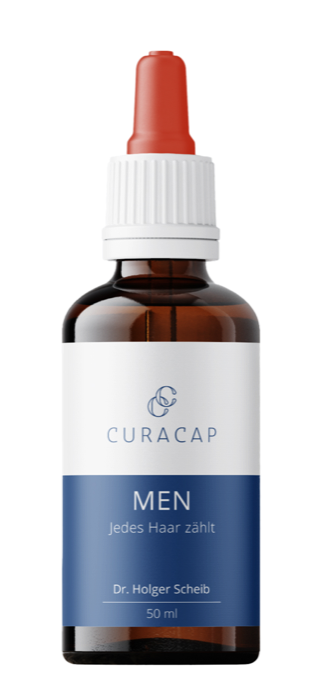
Understanding the biology of the scalp environment provides a more rational way to approach scalp care. CuraCap formulations were developed with this principle in mind.