Wissenschaft
Hair Density in Men: Why the Shaft Thins First
Hair density in men drops first through shaft diameter, only later through the number of hairs. What happens inside the follicle and what that means for you.
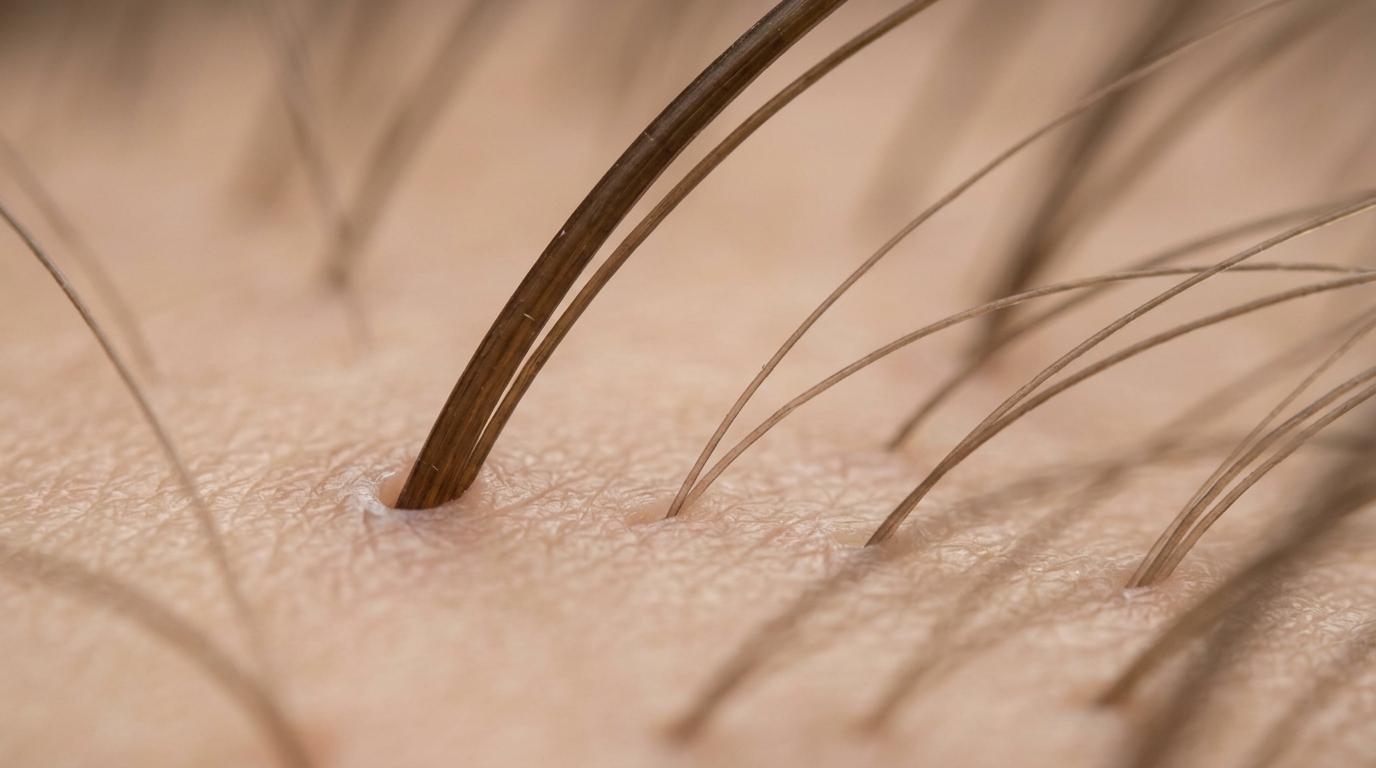
A single hair on a young man's head measures roughly 0.08 millimeters in diameter. That is not much, and yet this number alone determines how full a head of hair looks. If that same hair shrinks to 0.06 millimeters, it loses around 44% of its cross-sectional area, because area grows with the square of the diameter. The number of hairs stays the same. The head still looks thinner.
Anyone who notices at around 30 that their hair no longer holds its shape in the morning and that the scalp shows through under the bathroom light usually starts by counting the hairs in the brush. That is understandable. It is also the wrong place to look. In this article, I'll show you why the hair shaft in men almost always gets thinner long before the hair actually falls out, what happens inside the follicle in the process, and why that actually represents a real opportunity.
AT A GLANCE: In androgenetic alopecia, the hereditary hair loss common in men, hair follicles shrink over several growth cycles. Each new hair grows back thinner, shorter, and lighter. Dermatologists call this process miniaturization. Visible hair density therefore decreases long before the number of hairs measurably declines. In healthy scalp tissue, roughly seven strong terminal hairs surround each fine vellus hair; in advanced androgenetic alopecia, this ratio drops well below 4 to 1 (Whiting, 1993). As of September 2026.
What happens to a hair before it falls out?
The thinner shaft is the first visible sign of a process that begins in the follicle years earlier. Every scalp hair passes through a cycle of three phases. During the growth phase, known as the anagen phase, the follicle produces hair for two to six years. This is followed by a transitional phase lasting two to three weeks, and then a resting phase of around three months, at the end of which the old hair falls out and a new one pushes through (Paus and Cotsarelis, 1999).
In healthy hair, this cycle repeats for decades without significant change. In androgenetic alopecia, it shifts a little with each round. The growth phase gets shorter. The follicle gets smaller. The hair that grows back is finer than its predecessor.
Over several cycles, a strong terminal hair with a diameter above 0.06 millimeters gradually becomes a vellus hair. Vellus hairs are the fine, lightly pigmented hairs you also find on the forehead or forearm, often thinner than 0.03 millimeters. The follicle is not dead. It continues to produce hair, just hair that contributes almost nothing to visible density.
Why does this distinction matter? Because a shrunken follicle can still work, while an empty one cannot.
Why does the hair shaft get thinner first, and only later does the number of hairs decrease?
The sequence follows directly from the structure of the follicle itself. At the base of every hair follicle sits the dermal papilla, a small cluster of specialized connective tissue cells. Its volume is closely linked to the size of the hair the follicle produces (Elliott et al., 1999).
As a chemist, I think of a pasta machine. The dough passes through a die at the front, and the diameter of the holes determines whether you get spaghetti or penne. The machine keeps running even if you swap the die for one with smaller holes. You just get thinner pasta. The dermal papilla works in a similar way. When it loses cells, the follicle continues to produce hair, but with a smaller cross-section.
Only when this process is well advanced does the second change set in. The pause between the old hair falling out and the new one growing back gets longer. This empty interval has had its own name since 2002: kenogen (Rebora and Guarrera, 2002). The follicle then stands empty for a while.
Here is an overview of how the sequence unfolds:
| Stage | What happens in the follicle | What you see |
|---|---|---|
| Early | Papilla loses cells, growth phase shortens | Hair feels softer, style no longer holds |
| Middle | Hairs grow back thinner, shorter, and lighter | Scalp shows through in light and when wet |
| Late | Empty pauses between cycles grow longer | Visibly thinning areas, receding hairline, crown thinning |
In practical terms, this means that paying attention to hair thickness gives you years of lead time. Anyone who only reacts once hairs are actually missing has often already passed the most favorable window.
What role does DHT play in hair thinning?
The trigger for this shrinkage has been known for over eighty years. In 1942, James Hamilton published an observation in the American Journal of Anatomy about men who had been castrated before puberty (Hamilton, 1942). None of them developed baldness. Only when Hamilton administered testosterone to some of them did the typical hair loss begin in those with a genetic predisposition.
Today we know that testosterone is only the precursor. The enzyme 5α-reductase converts it into dihydrotestosterone, or DHT. DHT binds far more strongly to the androgen receptor than testosterone does and acts directly on the cells of the dermal papilla. There it triggers signals that shorten the growth phase and gradually shrink the follicle.
One point surprises many of my readers when they hear it for the first time. Men with hair loss do not typically have elevated testosterone levels in their blood. The hormone level is quite unremarkable. What matters is the sensitivity of the follicles. This varying sensitivity is genetically determined. And it resides in the follicle itself.
The single strongest genetic factor for early-onset hair loss in men is variants in the gene for the androgen receptor (Hillmer et al., 2005). This gene sits on the X chromosome, which men inherit from their mother. Hence the old rule of thumb about looking at your mother's father. It is not quite that simple, since dozens of additional genetic loci are now known. The rule still has a kernel of truth.
Why does thinning affect the hairline and crown first, but not necessarily the back of the head?
Genetic sensitivity is distributed unevenly across the scalp. Follicles from the frontal region contain more 5α-reductase and more androgen receptors than follicles from the back of the head (Sawaya and Price, 1997). The same amount of DHT in the blood therefore encounters follicles that respond to it in completely different ways.
This produces the familiar pattern that physicians still classify using the Hamilton-Norwood scale (Hamilton, 1951; Norwood, 1975). First the temples recede, then the crown thins, and in the end a fringe of hair remains above the ears and at the nape.
This fringe is remarkably stable. Hair follicles from the back of the head retain their resistance when transplanted to the frontal scalp (Orentreich, 1959). This principle has been called donor dominance ever since, and it is precisely why a hair transplant works. The surgeon does not create new hairs; he redistributes resistant follicles.
Why follicles at the front and back of the head respond so differently is not yet fully understood. One hypothesis points to embryonic development. The connective tissue of the frontal scalp partly originates from a different cell layer than that of the back of the head. Whether this accounts for the difference in receptor density has not been conclusively demonstrated. It is a plausible idea, nothing more.
How do you recognize early on that your hair is getting thinner?
Because miniaturization begins with diameter, the first signs show up in texture rather than quantity. A few observations can help you assess this yourself:
-
Your style loses hold. Hair that used to stay in place without product collapses after an hour.
-
The scalp shows through. Particularly after showering or under overhead lighting, it becomes visible at the temples and crown.
-
The hair at the hairline looks different. It appears shorter, lighter, and softer than the hair at the back of the head.
-
The finger test. Take a small pinch of hair from the back of the head and another from the hairline between thumb and index finger. If the front feels noticeably thinner, that is a sign of early miniaturization.
-
Photos in consistent light. A shot from above every three months, same lamp, same distance, shows changes more reliably than the daily glance in the mirror.
I consider that last point the most underrated. The mirror does not lie, but it acclimatizes you to gradual change. A photo from last spring does not.
In clinical practice, dermatologists use trichoscopy, the magnified examination of the scalp with a dermoscope. A marked spread in hair shaft diameters within a region is considered an early indicator of androgenetic alopecia. One of the main diagnostic criteria is a proportion of hairs thinner than 0.03 millimeters exceeding 10% in the frontal area (Rakowska et al., 2009). These criteria were developed in a study on women; the underlying principle of diameter variation is applied by physicians in men in the same way.
One distinction is worth making. If noticeably more hairs suddenly fall out, and they fall out at full thickness with a small white bulb at the root, that points more toward what is called telogen effluvium. This is increased shedding following fever, stress, crash dieting, or medication. It follows a different logic and often resolves on its own. If you are unsure, that question belongs with a dermatologist.
Can thinning hair become thicker again?
As long as a follicle is still producing hair, even fine hair, it can in principle still be influenced. A follicle that has stood empty for years, on the other hand, barely responds anymore. That is the real reason why acting early makes such a difference. The clock is not running against your hair; it is running against the responsiveness of the follicles.
So what actually works, and what does it cost you? The following overview organizes the common active ingredients by their mechanism and by the strength of the evidence:
| Active ingredient | Mechanism | Evidence | Trade-off |
|---|---|---|---|
| Finasteride 1 mg (oral) | inhibits 5α-reductase type 2, reduces DHT in the scalp by around two thirds (Drake et al., 1999) | established, multiple randomized trials (Kaufman et al., 1998) | prescription only, sexual side effects reported, effect ends after stopping |
| Minoxidil topical 5% | extends the growth phase, enlarges shrunken follicles | established (Olsen et al., 2002), mechanism only partially understood | scalp irritation, initial shedding possible, effect ends after stopping |
| Rosemary oil | mechanism unknown, improved circulation and anti-inflammatory effects are discussed | a single small study (Panahi et al., 2015), not replicated | few side effects, limited evidential weight |
| Topical caffeine | inhibits DHT's effect on follicles in cell culture | laboratory findings (Fischer et al., 2007), clinical data thin | well tolerated, effect in humans not established |
The rosemary study deserves a second look, because it gets cited so often. In that trial, rosemary oil performed no worse than 2%iges Minoxidil over six months in 100 men, with no significant difference in hair count (Panahi et al., 2015). That sounds impressive. But 2%iges Minoxidil is the weaker formulation, the study is small, and no one has since confirmed the result in a comparable piece of work. That does not mean the effect has been disproven. It simply means it has barely been investigated. Whether the effect exists, or whether no one has ever looked closely enough, cannot be read from the literature.
In my assessment, the most honest question is not which active ingredient is the best. The more honest question is which trade-off you are willing to accept. Finasteride and minoxidil have the strongest evidence and the greatest commitment, and both only work for as long as you take them. Anyone interested in that route should discuss it with a dermatologist who has no stake in a later transplant. Gentler approaches carry fewer risks and fewer proofs. Both are legitimate choices, as long as you make them with your eyes open.
What can a healthy scalp contribute to stronger hair?
Alongside the active ingredients, there is a factor that often gets lost in the discussion. Scalp biopsies from men with androgenetic alopecia show a striking concentration of inflammatory cells around the upper sections of the follicles (Jaworsky et al., 1992). Since that observation in 1992, researchers have been discussing a so-called microinflammation as a possible amplifier of miniaturization.
Honestly: whether this inflammation is a cause, a consequence, or simply a companion is something nobody knows with any certainty. That it exists is documented in biopsies. That a calm, well-nourished scalp provides better conditions for follicles is something I consider plausible after many years working with active ingredients. Proven in the sense of a large comparative trial, it is not.
Scalp care does not stop DHT. It does not replace medically prescribed treatment either. What it can do is prepare the ground in which every hair grows. Think of a lawn on compacted, dried-out soil. You can sow the best seed, but less of it will take on poor ground.
In everyday terms, that means:
-
Wash gently. Aggressive surfactants and heavily fragranced shampoos irritate the scalp unnecessarily. Frequent washing does not damage hair, as long as the product is mild.
-
Avoid alcohol on irritated skin. Many hair tonics contain high concentrations of ethanol, which dries out the skin barrier. Burning or tightness is a warning sign.
-
Protect thinning areas from the sun. Where less hair grows, more UV radiation reaches the scalp. A cap or a light sunscreen is a sensible precaution.
-
Stay consistent. A hair cycle takes months. Any routine needs at least four to six months before you can fairly assess its effect.
The fourth point matters most to me. Most routines fail because of patience, not chemistry.
For exactly this kind of care for the male scalp, we formulated CuraCap MEN: high-purity, high-concentration, and free of additives that place unnecessary strain on the barrier. It is one building block for the scalp, not a substitute for minoxidil or finasteride, and not a promise of new hair. Healthy scalp, stronger hair. That is the mechanism we stand behind, and we stand behind it with a clear understanding of its limits.
What remains in the end is good news. A thinning hair shaft shows you a process that is still running, not a verdict that has already been handed down. How to combine active ingredients sensibly, and what role dosage plays in that, we will look at in a dedicated article.
FAQ
Can thin hair become thicker again? As long as the follicle is still producing hair, that is in principle possible. Minoxidil and finasteride have shown in studies that shrunken follicles can produce thicker hairs again. Follicles that have stood empty for years barely respond anymore.
At what age does hair start thinning in men? Androgenetic alopecia can begin shortly after puberty. The proportion affected increases with each decade of life and reaches around half of all men by age 50 ([